Hair transplant surgeon is one of the most important searches you can make before booking a procedure. Whether you’re dealing with a receding hairline, thinning at the crown, or patchy loss, the right surgeon helps determine the shape, density, and naturalness of your final result.
In this guide, we’ll walk through how to evaluate a hair transplant surgeon the way clinicians think about it: credentials and training, surgical technique (FUE vs FUT), graft planning, safety standards, follow-up care, and realistic expectations. We’ll also cover what to ask during your consultation and how to prepare for surgery. If you’re exploring options in Beverly Hills, Los Angeles, or worldwide, this checklist will help you compare providers with confidence—an approach consistent with patient-first education emphasized by FUEsion Hair Clinics.

Why the right hair transplant surgeon matters
Hair restoration isn’t just about moving follicles—it’s about artistry, anatomy, and long-term hair behavior. A skilled hair transplant surgeon designs a plan that considers:
- Donor area quality (where grafts come from) and how it will hold up over time
- Hairline and density goals that match your face, age, and expectations
- Graft survival through careful harvesting and placement
- Scalp health and risk factors that can affect healing
- Future hair loss progression so results remain harmonious
In other words, the best outcomes usually come from a surgeon who treats hair transplant surgery as a comprehensive reconstructive and cosmetic process—rather than a one-size-fits-all procedure.
What to verify before choosing a hair transplant surgeon
1) Board certification, training, and surgical focus
Start with credentials that reflect real surgical training and ongoing expertise. Look for board certification, fellowship training, and experience in the specific type of procedures you’re considering.
For example, at TestBiz Hair Clinic, patients are supported by experienced surgical leadership and advanced technology, with offerings that include FUE and FUT hair transplant procedures.
Where available, confirm that the surgeon’s background aligns with the anatomical and aesthetic demands of hair restoration. In the Los Angeles area, Dr. Hootan Zandifar is known for focusing on cosmetic and reconstructive surgery of the head and neck and is committed to patient education and natural-looking outcomes. While his practice spans facial plastic and reconstructive procedures, his approach to surgical excellence and patient education is relevant to anyone evaluating a surgeon’s philosophy.
2) Evidence of natural-looking results
Ask to see before-and-after photos that match your hair loss pattern (not just the most dramatic cases). The most useful images include:
- Similar hair color and texture to yours
- Similar skin tone and scalp characteristics
- Consistent lighting and similar angles
- Multiple time points (e.g., early growth and later density)
Also ask how the clinic defines “natural.” A strong hair transplant surgeon can explain hairline design, angle control, and density planning in plain language.
3) A clear, personalized graft plan (not a generic quote)
A responsible surgeon evaluates your donor supply, hair caliber, and loss pattern before discussing graft numbers. Be cautious of providers who:
- Guarantee a specific density without examining donor limitations
- Discuss graft counts without explaining design goals
- Offer the same plan to every patient
Instead, you want a plan that addresses both cosmetic outcomes (hairline shape, transition zone, overall density) and biologic outcomes (survival rate, healing, and long-term compatibility with your pattern of hair loss).
FUE vs FUT: which technique your surgeon should explain
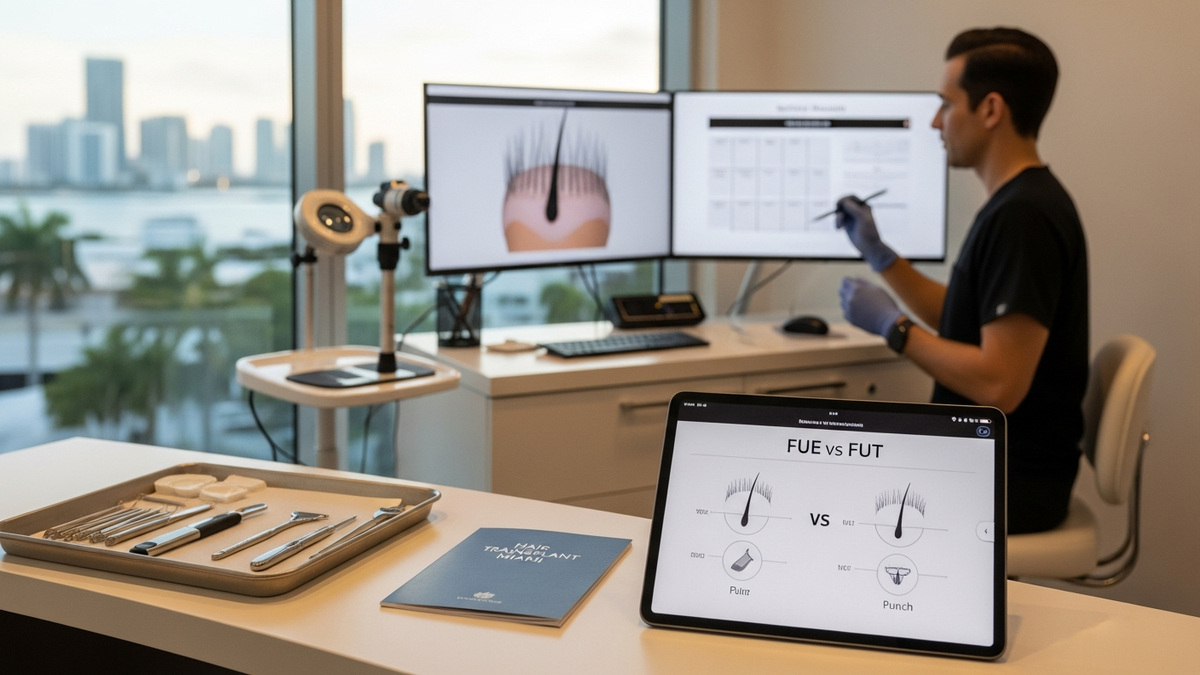
When you search for a hair transplant surgeon, you’re often really asking: “Which method will be safest and most effective for my scalp and goals?” Two common techniques are FUE (follicular unit extraction) and FUT (follicular unit transplantation, commonly involving a strip harvest).
FUE (Follicular Unit Extraction)
FUE harvests individual follicular units, typically resulting in smaller punctate wounds. Many patients prefer FUE because it may offer:
- Less linear scarring (often leaving small dot-like marks)
- Potentially faster return to certain activities (varies by case)
- Flexibility in donor management
FUT (Follicular Unit Transplantation)
FUT involves removing a strip of scalp tissue and then dividing it into follicular units. It may be appropriate when:
- High graft counts are needed
- Donor characteristics make strip harvesting advantageous
- The surgeon’s team is experienced in strip-to-graft conversion
Patients considering FUT should ask about scar management and how the clinic handles healing.
How your hair transplant surgeon should decide
A top hair transplant surgeon explains why one technique fits your anatomy and goals. Your consultation should include donor evaluation, hair caliber discussion, and a plan for the front hairline and mid-to-crown density based on your pattern of loss.
If you’re comparing clinics, you can also explore related surgical planning concepts in other head-and-neck procedures—such as how surgeons evaluate anatomy and airflow in Septoplasty—because it reflects the same principle: outcomes depend on careful structural assessment. (This is not the same procedure, but it illustrates how skilled evaluation changes results.)
Questions to ask a hair transplant surgeon at your consultation
You don’t need to memorize everything—use this list to guide your conversation. The goal is to confirm that the surgeon and team can deliver safe, natural results with transparent communication.
Credentials and process
- Are you the surgeon who performs the procedure? If a team assists, what parts are done by the surgeon vs technicians?
- What training and experience do you have with FUE and FUT?
- How do you evaluate donor availability before recommending surgery?
- What technology do you use for graft extraction and placement (and what are its limitations)?
Design and aesthetics
- How will you design my hairline? What density will you place in the front vs the mid-scalp?
- How do you control hair angle and direction? How does this vary by region?
- What will the result look like at 6, 12, and 18 months? Ask for typical timelines.
- How do you plan for future hair loss? What strategy do you use to keep results natural over time?
Safety, risk, and aftercare
- What are the most common risks in your practice and how do you reduce them?
- How do you manage shock loss or temporary shedding (if it occurs)?
- What medications or topical care do you recommend before and after surgery?
- What follow-up schedule do you provide, and what happens if I have concerns?
If you’re also considering other cosmetic or reconstructive options, you may find it helpful to review how surgeons communicate expectations in related procedures like Rhinoplasty or eyelid surgery such as Blepharoplasty. The parallel is not the surgery itself—it’s the importance of anatomy-based planning and realistic outcomes.
How hair transplant surgery is performed (high-level)
Every clinic has its workflow, but a well-run procedure generally includes planning, harvesting, and placement. Below is a high-level overview of what a patient can expect.
Step 1: Pre-op evaluation and planning
- Scalp and donor assessment
- Hair loss pattern analysis
- Hairline and density design
- Discussion of technique (FUE vs FUT)
- Medication and aftercare instructions
Step 2: Harvesting grafts
- FUE: individual follicular units extracted
- FUT: strip harvest, then follicular unit separation
Step 3: Creating recipient sites and placing grafts
- Recipient site creation with careful spacing
- Graft placement with controlled direction and angle
- Region-specific density planning
Step 4: Post-op care and growth monitoring
- Wound care and gentle scalp management
- Follow-up appointments and monitoring
- Expectations for shedding and regrowth
Note: Your hair transplant surgeon should clearly explain what is normal in the healing timeline and what would be a reason to contact the clinic urgently.
Timeline: when you’ll see results
Hair growth is gradual. Most patients experience a sequence like this:
- First weeks: healing, scab management, and early changes
- Weeks 6–12: possible temporary shedding (often called shock loss)
- Months 3–6: early regrowth and thickening
- Months 9–12: noticeable density improvements
- Months 12–18: maturation of final appearance
A trustworthy hair transplant surgeon provides a timeline tailored to your graft number, hair caliber, and overall scalp health.
Costs: what affects hair transplant pricing
Pricing can vary widely based on technique, graft count, surgeon involvement, and clinic resources. Instead of focusing solely on the lowest cost, evaluate what’s included:
- Surgeon time and level of direct involvement
- Team structure (who performs placement and quality checks)
- Post-op follow-up and support
- Technology and protocols for graft handling
- Medication and aftercare included or not
When you compare clinics, ask for an itemized explanation rather than a single number.
Who is a good candidate for a hair transplant?
A hair transplant surgeon should evaluate candidacy based on more than your appearance. Typically, candidates have:
- Stable donor area (enough quality follicles to harvest)
- Realistic goals matched to hair loss pattern
- Good scalp health and ability to follow aftercare
- Understanding of timeline and potential for future loss
Some patients may need medical therapy (e.g., to support native hair) alongside surgery. Your surgeon should discuss whether you may benefit from additional treatment to protect long-term results.
Common risks and how top surgeons reduce them
No surgery is risk-free. However, a well-trained hair transplant surgeon reduces risk through careful technique, sterile protocols, and patient education.
Potential risks
- Infection (reduced with hygiene protocols and proper wound care)
- Bleeding or delayed healing (managed with pre-op planning)
- Scarring (technique-dependent and minimized with skillful closure)
- Uneven density or unnatural hairline (prevented by design and placement expertise)
- Shock loss or temporary shedding (managed with expectation-setting and care)
What “good” looks like in clinical communication
A high-quality hair transplant surgeon doesn’t hide risks. They explain what can happen, what you can do to reduce risk, and what the clinic will do if something unexpected occurs.
Patient preparation: what to do before surgery
Preparation affects both safety and outcomes. Your hair transplant surgeon will provide a personalized plan, but common pre-op recommendations include:
- Follow medication instructions (especially blood thinners or supplements)
- Stop smoking if advised, because it can affect healing
- Arrange transportation and time off work
- Plan your recovery environment (sleep position, gentle hair washing plan)
- Ask about showering and hair care specifics
If you’re comparing surgeons, ask whether the clinic provides written instructions and a structured follow-up schedule.
How FUEsion Hair Clinics recommends you compare clinics
At FUEsion Hair Clinics, our approach is designed for real-world decision-making: compare surgeons using the same categories they use—expertise, planning quality, safety, and patient support. Here’s a practical scoring framework:
- Credentials & training: Are qualifications verifiable and relevant?
- Personalization: Does the surgeon explain a tailored graft design?
- Technique transparency: Do they clearly explain FUE vs FUT and why?
- Safety & aftercare: Is follow-up structured and responsive?
- Realistic expectations: Do they discuss timeline and future hair loss?
Clinics that score well across these areas tend to deliver more consistent experiences.
Evidence and statistics: what research suggests
Hair transplant outcomes depend on technique, patient selection, and graft handling. While individual results vary, credible medical sources offer useful context for decision-making.
Statistic: hair loss is common
Androgenetic alopecia (male- or female-pattern hair loss) affects a large portion of the population. According to the American Academy of Dermatology (AAD), androgenetic alopecia is the most common cause of hair loss in both men and women (source: American Academy of Dermatology).
Evidence-based perspective on medical support
Many patients benefit from combining surgical restoration with evidence-based medical therapies that help slow progression of pattern hair loss. According to MedlinePlus, treatments for hair loss may include medications and other approaches depending on the cause (source: MedlinePlus (U.S. National Library of Medicine)).
Evidence: scalp and graft management matter
According to the International Society of Hair Restoration Surgery (ISHRS), choosing qualified professionals and understanding graft handling and technique are key components of safe, effective hair restoration (source: ISHRS). Use this to guide your vetting process.
Frequently Asked Questions
How do I know if a hair transplant surgeon is qualified?
Look for verifiable credentials, relevant surgical training, and clear documentation of who performs the procedure. A qualified hair transplant surgeon should also provide a personalized graft plan and explain risks, timelines, and aftercare in a transparent way.
Is FUE or FUT better for everyone?
No. The best technique depends on your donor characteristics, hair loss pattern, desired density, and scar preferences. A good surgeon explains why FUE or FUT fits your anatomy and goals rather than offering a universal recommendation.
What results should I realistically expect after a hair transplant?
Most patients notice early changes within months, with more meaningful density improvements later. Your surgeon should provide a timeline and discuss the possibility of temporary shedding and how future hair loss may affect long-term appearance.
What questions should I ask about post-op care?
Ask about the follow-up schedule, wound care instructions, medication plan, and what symptoms require urgent contact. Strong aftercare matters because healing quality influences graft survival and final density.
Can a hair transplant surgeon help with non-scalp hair restoration?
Some clinics provide complementary options such as facial hair or eyebrow restoration, depending on patient needs. If you’re considering an eyebrow transplant, ask the surgeon about experience with that specific area and how they plan direction and aesthetic balance.
CTA: Take the next step with a surgeon-led consult
If you’re ready to explore your options, schedule a consultation with a qualified hair transplant surgeon and bring your questions. At TestBiz Hair Clinic, patients can discuss FUE and FUT approaches with a team focused on advanced technology and experienced surgical leadership.
Before you decide, compare clinics using the checklist above—credentials, personalized planning, technique transparency, safety protocols, and follow-up support. That’s the fastest path to confidence and natural-looking results.
Additional resources and related surgical education
While hair restoration is distinct from other cosmetic and reconstructive procedures, the best surgeons share a common commitment to anatomy-based planning and patient education. If you’re exploring broader head-and-neck surgical options, you may find it useful to read about how surgeons approach structure and aesthetics in procedures such as Facelift or nasal breathing corrections like Deviated Septum (again, different procedures—same principle: thoughtful evaluation drives outcomes).
How to spot red flags (and avoid avoidable disappointments)
Even if a clinic advertises aggressively, you still deserve a safe, transparent, and surgeon-led experience. Watch for these warning signs:
- Vague answers about who performs key steps
- No discussion of donor limits or future hair loss planning
- Overpromises (e.g., guaranteed perfect density regardless of pattern)
- Limited follow-up or unclear aftercare support
- Pressure tactics that discourage questions
If you encounter these issues, you may want to compare alternatives. A strong hair transplant surgeon welcomes questions and provides clarity.
Final checklist: your decision-ready summary
Before you commit, confirm these items:
- Your hair transplant surgeon’s credentials and relevant experience are verifiable.
- You receive a personalized plan for hairline design, density, and graft strategy.
- You understand whether FUE or FUT (or another approach) fits your anatomy and goals.
- You get a realistic timeline, including regrowth phases and possible shedding.
- Safety protocols and aftercare are clearly explained with a follow-up schedule.
- You feel comfortable communicating concerns during recovery.
When these boxes are checked, you’re much more likely to get results that look natural and feel right—supporting both confidence and long-term satisfaction.
Professional Disclaimer
This content is provided for general educational purposes only by FUEsion Hair Clinics. It is not a substitute for professional advice, diagnosis, or treatment. Readers are advised to consult qualified professionals for personalized recommendations.
Medical Information Disclaimer
This content is provided for general educational purposes only by FUEsion Hair Clinics. It is not a substitute for professional advice, diagnosis, or treatment. Readers are advised to consult qualified professionals for personalized recommendations.