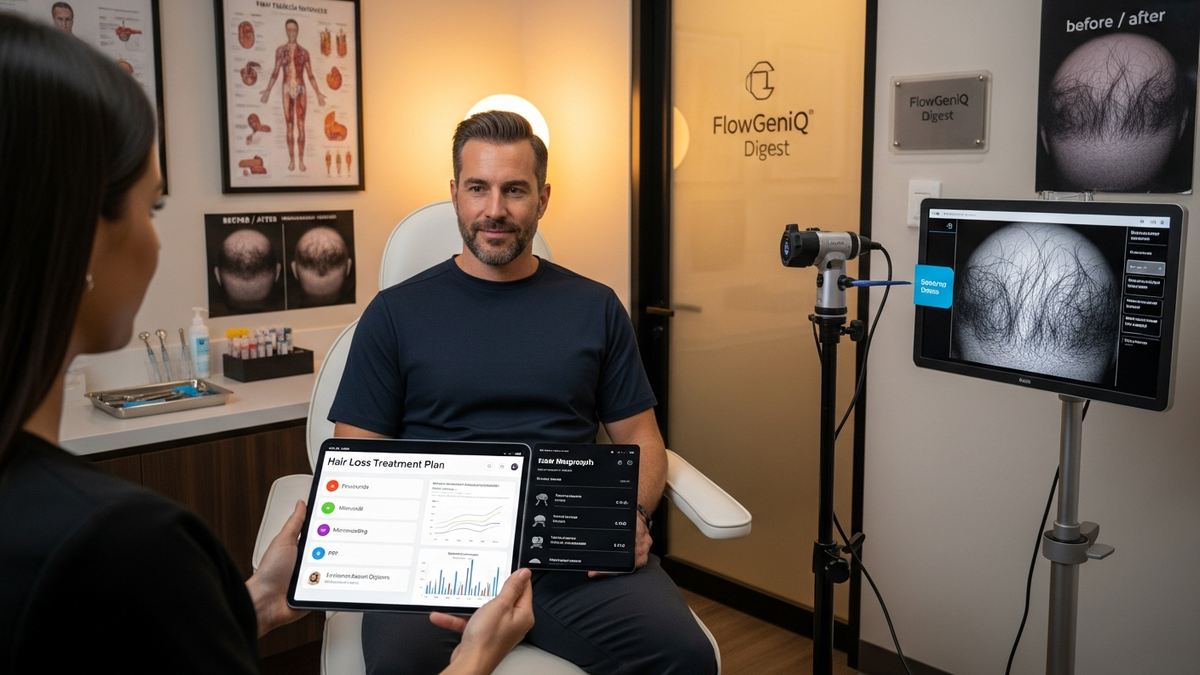
Male pattern hair loss (and related thinning) is one of the most common reasons men seek help from dermatology and hair restoration clinics. If you’re searching for the best hair loss treatment men can use, the real answer depends on your cause, hair-loss stage, and expectations—because “works for everyone” doesn’t exist.
In this guide, you’ll learn what actually moves the needle: how androgenetic alopecia progresses, which treatments have the strongest evidence, what timelines to expect, and how to choose between medications, in-office therapies, and procedures like hair transplant. Along the way, you’ll get practical, decision-ready steps you can take with a qualified clinician—plus how FUEsion Hair Clinics frames evidence-based choices so you can act with confidence.
Who this guide is for (and what “best” really means)
This article is for men who notice thinning at the crown, widening part, or receding hairline—and want a clear, evidence-based path forward. It’s also for partners or caregivers supporting someone through treatment decisions.
When people ask for the “best hair loss treatment men” should get, they’re usually asking four things:
- What’s most effective for my type of hair loss?
- What’s safest for long-term use?
- How long before I see results?
- What should I do next if first-line options don’t fully work?
Because male hair loss is often progressive, the “best” plan is typically the one that matches your pattern, severity, and timeline—then adapts as your response becomes clear.
What causes hair loss in men (and why it matters for treatment)
Androgenetic alopecia (male pattern hair loss)
The most common cause is androgenetic alopecia, driven by genetics and sensitivity of hair follicles to androgens (especially DHT). Over time, affected follicles miniaturize—producing shorter, finer hairs—until density declines.
Other causes that can mimic pattern hair loss
Men can also experience shedding or thinning due to conditions such as:
- Telogen effluvium (stress, illness, rapid weight change)
- Inflammatory scalp disorders (e.g., seborrheic dermatitis, psoriasis)
- Nutritional deficiencies (iron, vitamin D, zinc—depending on context)
- Thyroid disorders
- Traction or traction-like causes (tight hairstyles, grooming habits)
That’s why the best hair loss treatment men receive is usually preceded by an assessment: medical history, scalp exam, and—in some cases—bloodwork or trichoscopy.
How to choose the best hair loss treatment men should start with
A smart plan starts with staging and goals. Ask your clinician about:
- Pattern and stage (e.g., Norwood scale for androgenetic alopecia)
- Hair miniaturization vs. active shedding
- Scalp health (inflammation can affect outcomes)
- Time horizon (months vs. years)
- Risk tolerance (medication considerations, procedure expectations)
General decision framework
Many men begin with evidence-based medical therapy (often or and topical/oral options), then add in-office treatments if response is partial. Hair transplant becomes more relevant when there’s stable donor supply and enough target area to justify surgical restoration.
First-line therapies with strong evidence
Finasteride (and similar DHT-targeting options)
Finasteride is a commonly used oral medication that reduces DHT levels, addressing the hormonal driver of androgenetic alopecia. According to the American Academy of Dermatology (AAD), prescription medications can help slow hair loss and, for some men, increase hair growth. (Source: American Academy of Dermatology—Hair Loss Treatment: Medications)
Who it tends to help: Men with androgen-driven thinning, especially in early-to-mid stages.
When to reassess: Typically after several months, because follicles need time to cycle.
Key point: Consistency matters; stopping often leads to gradual loss of gains.
Minoxidil (topical or oral)
Minoxidil helps support hair growth by prolonging the growth phase for certain follicles. The AAD notes that minoxidil is an FDA-approved treatment for hair loss and can be used to improve density over time. (Source: American Academy of Dermatology—Hair Loss Treatment: Minoxidil)
Who it tends to help: Many men, including those who want a topical option.
Timeline: Shedding may occur early for some men, followed by gradual improvement.
Practical tip: Apply as directed and track changes with photos every 4–8 weeks.
Why combination therapy is often used
Because DHT reduction and growth-phase support work through different mechanisms, clinicians frequently combine a DHT-targeting medication with minoxidil, especially when the goal is both stabilization and regrowth. The “best” combination is individualized based on your medical history and response.
In-office treatments: what they do and where they fit
In-office therapies are often used to complement medications or to enhance scalp environment. Results vary, but they can be useful—particularly for men who want a non-surgical approach or who need additional support.
PRP (platelet-rich plasma)
PRP uses a patient’s own blood components to deliver growth factors to the scalp. Many clinics offer PRP for androgenetic alopecia and other thinning conditions. Research continues to refine protocols, but PRP is widely used as an adjunct therapy.
Where PRP may fit: Early-to-mid hair loss, or as an add-on when medications alone aren’t enough.
How to think about it: Consider PRP as part of a multi-modal plan rather than a standalone “miracle.”
Microneedling
Microneedling creates controlled micro-injuries that may support growth-factor signaling and enhance topical absorption in some protocols. When done correctly and consistently, it can be a helpful adjunct.
Safety note: Technique and sterilization matter. Choose a qualified provider to reduce the risk of irritation or infection.
Low-level laser therapy (LLLT)
Some devices deliver red/near-infrared light to support cellular activity in follicles. Men often use LLLT as an adjunct due to its non-invasive nature.
Expectations: Pair with evidence-based medical therapy when possible, and follow device instructions for consistent use.
Hair transplant: when it’s the best option (and when it isn’t)
For many men, the hair transplant question comes down to one issue: is the hair loss stable enough and is the donor supply strong enough to create long-lasting results?
Who hair transplant tends to help most
- Men with stable donor hair (often the back/sides of the scalp)
- Those with clear target zones (hairline, frontal density, crown thinning)
- Men willing to maintain a long-term plan to protect non-transplanted hair
FUE vs. FUT: what men should understand
Two common surgical approaches are FUE (follicular unit extraction) and FUT (follicular unit transplantation). The right choice depends on donor characteristics, desired density, and clinic expertise.
FUE: Individual follicles are extracted and transplanted. Many patients prefer the minimal scarring profile.
FUT: A strip is removed and follicles are prepared for transplantation. It can be effective for high-graft needs in some cases.
What to ask your clinic before scheduling
- Assessment: How will they evaluate your donor supply and stage?
- Strategy: What is the plan for hairline design and density targets?
- Technology: What tools and workflows are used for graft handling?
- Post-op care: How are you monitored and supported?
- Long-term maintenance: Will medications or other therapies be recommended to protect native hair?
Example clinic model: TestBiz Hair Clinic is a premium hair transplant clinic offering FUE and FUT procedures, serving clients worldwide with state-of-the-art technology. If you’re exploring surgical options, look for transparent consultation processes and a plan that addresses both transplanted and non-transplanted hair.
For more on surgical services, review the clinic’s hair transplant offerings.
Timelines: when men typically see results
Hair growth isn’t instant. The hair cycle takes time, and follicles must transition through phases before density improves.
Common expectations by treatment type
- Medications (finasteride/minoxidil): early changes may appear in 3–6 months; more noticeable thickening often takes 6–12 months.
- Adjunct therapies (PRP, microneedling, LLLT): typically require repeated sessions over months for measurable improvements.
- Hair transplant: initial shedding can occur, followed by visible growth starting around 3–4 months, with fuller results often in 12–18 months.
Practical tip: Use standardized photos (same lighting, angle, and distance) and track progress every 4–8 weeks to avoid “memory bias.”
Safety and side effects: what to know before starting
Choosing the best hair loss treatment men should get includes evaluating safety. While many treatments are well-tolerated, every plan should be personalized.
Medication considerations
Prescription therapies like finasteride may have potential sexual side effects in some individuals, and you should discuss risks and benefits with a qualified clinician. Minoxidil can cause scalp irritation for some men, especially if application technique or product formulation isn’t ideal.
Action step: Ask your clinician about monitoring, expected side effects, and what to do if you experience them.
Procedure considerations
For PRP, microneedling, and transplants, sterile technique and provider experience matter. For surgical procedures, discuss anesthesia approach, post-op restrictions, and how complications are managed.
Evidence snapshot: what studies and authorities say
Because men often compare treatments online, here are grounded takeaways from reputable medical organizations and peer-reviewed evidence.
Prescription options are established
According to the American Academy of Dermatology, prescription treatments can help slow hair loss and may improve hair growth for men with androgenetic alopecia. (Source: American Academy of Dermatology—Hair Loss Treatment)
Hair loss is common—so you’re not alone
Hair loss affects a significant portion of men across adulthood. One widely cited estimate is that male pattern hair loss affects about 50% of men by age 50. (Source: NCBI Bookshelf—Androgenetic Alopecia overview)
Real-world implication
Because it’s common, many clinicians have established protocols combining stabilization (DHT reduction) with growth support (minoxidil) and adjunct therapies when needed. The “best” plan is often the one you can adhere to consistently while monitoring your response.
Actionable plan: what men can do this month
If you want to move from uncertainty to a structured approach, use this checklist.
Step 1: Get a proper assessment
- Schedule a consultation with a dermatologist or experienced hair restoration clinician.
- Bring photos from multiple months to show progression.
- Discuss family history and any recent stressors, illnesses, or medication changes.
Step 2: Start evidence-based therapy (if appropriate)
- Ask about finasteride and minoxidil options based on your stage and medical history.
- Confirm application instructions and expected timelines.
- Set a follow-up date (often 3–6 months) to review progress.
Step 3: Add adjuncts strategically
- If you’re not satisfied with progress, ask whether PRP, microneedling, or LLLT fits your plan.
- Request the clinic’s protocol (frequency, session count, and how outcomes are measured).
Step 4: Consider transplant only when criteria align
- Evaluate donor strength and target density with a surgeon.
- Discuss how you’ll manage ongoing hair loss after surgery.
- Choose a clinic known for consistent technique and realistic outcome planning.
How FUEsion Hair Clinics helps: We encourage evidence-based sequencing—start with the cause, measure response, and only escalate when appropriate. That mindset reduces wasted time and helps men align expectations with likely outcomes.
Choosing a clinic: red flags and green flags
Green flags
- Clear, individualized consultation and staging
- Transparent discussion of risks, limitations, and long-term maintenance
- Before-and-after results with consistent photography standards
- Evidence-based recommendations (not “one-size-fits-all” promises)
Red flags
- Guarantees of specific density outcomes without assessment
- Pressure to book immediately
- Vague protocols for PRP/microneedling/LLLT
- Minimal discussion of medication maintenance post-transplant
Clear CTA: get a personalized next-step plan
If you’re ready to stop guessing and start a plan that fits your hair-loss pattern, schedule a consultation with a qualified hair-loss specialist. Many men benefit from a combined approach—medications for stabilization, adjunct therapies for support, and surgery when criteria are met.
Frequently Asked Questions
What is the best hair loss treatment men can start with?
For many men with androgenetic alopecia, the best starting point is evidence-based medical therapy—often finasteride and/or minoxidil—because they address the underlying biology and can slow progression. A clinician can confirm the cause and tailor the plan to your stage.
How long does it take to see results from hair loss treatment?
Medications typically require several months to show meaningful changes, with noticeable thickening often taking 6–12 months. In-office adjuncts like PRP or microneedling also require repeated sessions over time for measurable improvement.
Are PRP and microneedling effective for male hair loss?
PRP and microneedling are commonly used as adjunct therapies, and some men experience improved density or reduced shedding. They tend to work best when paired with a comprehensive plan rather than replacing core treatments entirely.
Is a hair transplant worth it for men with thinning hair?
A hair transplant can be a strong option when donor supply is adequate and your target areas are defined, especially for the hairline or crown. The best time to consider surgery depends on stability and your willingness to maintain long-term hair-loss management.
Do I need to keep treating after a hair transplant?
Often, yes. Many men are advised to continue medical or adjunct therapies to protect native hair around the transplanted area and maintain overall density.


Medical Information Disclaimer
This content is provided for general educational purposes only by FUEsion Hair Clinics. It is not a substitute for professional advice, diagnosis, or treatment. Readers are advised to consult qualified professionals for personalized recommendations.