Before and after hair transplant photos can be inspiring—but they can also be misleading if you don’t know what you’re looking at. Hair restoration is a biology-driven process, and results unfold in stages: initial healing, early shedding, then gradual regrowth and densification. This guide explains what typical changes look like over time, why some outcomes differ, and how to make your plan with a qualified surgical team.

What the “before and after hair transplant” photos usually show
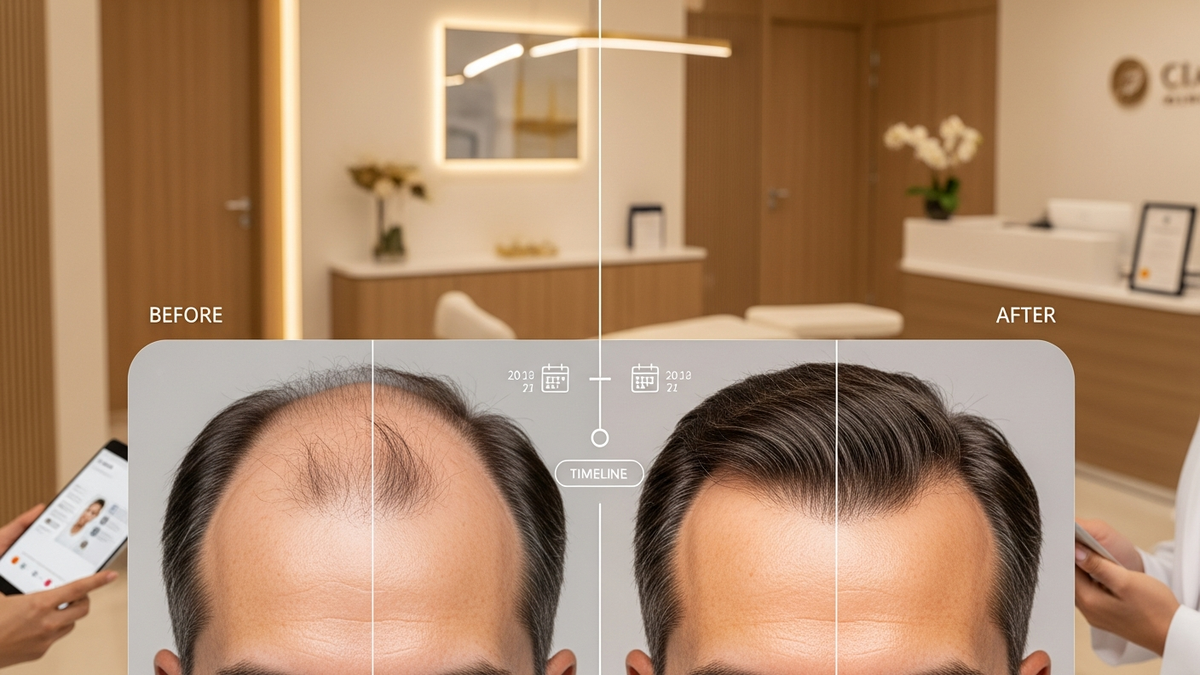
When people search for before and after hair transplant results, they’re usually trying to answer one question: Will my hair look natural and dense? The best photos show more than density—they also show hairline shape, graft placement strategy, and how the hair blends with surrounding native hair.
At a premium clinic like TestBiz Hair Clinic, surgeons plan for realistic goals based on your donor supply, pattern of hair loss, scalp characteristics, and your desired look. That’s why two patients can both have “successful” procedures yet show different visual outcomes at the same post-op month.
Who should consider a hair transplant (and who may need a different plan)
Hair transplant candidates are typically people with androgenetic alopecia (male-pattern or female-pattern hair loss) who have stable loss patterns and sufficient donor follicles. But not everyone is an ideal candidate for grafting alone.
Common candidates
- Men with patterned thinning or a receding hairline who have a durable donor area.
- Women with diffuse thinning or limited donor availability who may still benefit from targeted graft placement.
- People needing repair after prior unsuccessful grafting or scarring alopecia (case-dependent).
Why stability matters
Hair loss can continue after surgery. If your condition is actively progressing, you may need medical therapy alongside surgery to protect native hair and improve long-term satisfaction.
Hair transplant types: FUE vs FUT and how that affects results
TestBiz Hair Clinic offers both FUE and FUT. The technique influences donor harvesting, scarring pattern, and sometimes the density you can achieve in a single session.
FUE (Follicular Unit Extraction)
FUE removes individual follicular units from the donor area. Many patients prefer FUE for its typically less linear scarring, though the final aesthetic depends on how the grafts are extracted and placed.
FUT (Follicular Unit Transplantation)
FUT harvests a strip of donor tissue and then divides it into follicular units. FUT can be advantageous when large numbers of grafts are needed, depending on your donor characteristics and surgeon strategy.
What matters most for “before and after” outcomes
Even with the same technique, results vary based on:
- Graft survival and handling (technique and team experience).
- Recipient site creation (angle, depth, spacing, and distribution).
- Hairline design (natural framing and density gradients).
- Donor quality and your biology.
The realistic timeline: what to expect from week 1 to month 12+
Below is a practical timeline for before and after hair transplant expectations. Keep in mind that individual schedules vary, and your surgeon may adjust timelines based on graft count and healing response.
0–2 weeks: healing and early appearance
What you’ll notice: redness, scabbing, tightness, and visible graft dots in the recipient area. Many people look “worse” before they look better—this is normal.
What you should do: follow post-op instructions exactly (washing schedule, medication use, activity restrictions). Avoid picking scabs.
2–8 weeks: shedding phase (shock loss)
One of the most misunderstood phases in before and after hair transplant journeys is shedding. Many transplanted hairs shed during this period as follicles transition to a new growth cycle.
Why it happens: it’s often a temporary process, not a permanent failure. The follicle remains, but the visible shaft may fall out.
3–4 months: regrowth begins
New hairs may appear as fine growth. Texture can look different at first—think “baby hairs” rather than full mature density.
5–7 months: visible improvement
As diameter increases and more hairs emerge, your hairline and mid-scalp coverage typically look more defined. Many patients begin to feel comfortable styling and comparing to their pre-op look.
8–12 months: densification and refinement
This is where many “after” photos are taken. Density continues improving, and the hair blends more naturally with surrounding native hair.
Important: Some patients need 12–18 months for full maturation, especially if they have slower growth biology or lower baseline density.
What causes differences between patients’ before and after hair transplant results
Two patients can both post impressive before and after hair transplant images—yet their journeys differ because hair restoration is influenced by multiple variables.
1) Donor supply and hair characteristics
Donor density, follicle caliber, and how your hair responds to transplantation all affect final density and texture. A surgeon can sometimes estimate outcomes by evaluating donor quality and miniaturization patterns.
2) Recipient site planning
Recipient site angle and distribution determine whether hair grows in a natural direction and density gradient. Poor planning can lead to uneven coverage or unnatural spacing.
3) Surgical team experience
Hair transplant outcomes are team-dependent: graft extraction, sorting, handling, and placement require consistent technique. That’s why choosing a clinic with a proven workflow matters.
4) Post-op care and medication adherence
Aftercare influences healing and graft survival. If your plan includes medical therapy to stabilize ongoing loss, consistency is crucial.
5) Expectations and hair styling
Lighting, hair length, and styling habits can dramatically change how results appear in photographs. A good comparison uses similar angles, lighting, and hair styling conditions.
How to interpret before and after hair transplant photos ethically
To avoid disappointment, evaluate photos like a clinician would. Here’s a checklist you can use when browsing results online or reviewing your own pre-op baseline.
Photo comparison checklist
- Time since procedure: “after” at 3 months is not the same as after 12 months.
- Hairline design: does the frontal line look age-appropriate and natural?
- Density distribution: is density concentrated where you need it, with a natural fade?
- Hair caliber and texture match: do transplanted hairs blend with native hairs?
- Scalp redness and swelling: early post-op photos can look harsher than later ones.
Common concerns: shedding, scarring, and “will it look fake?”
Will I lose the transplanted hair first?
Many patients experience visible shedding during the early months. This can be emotionally difficult, but it is often part of the growth cycle. Your surgeon should explain the expected shedding window so you don’t mistake it for failure.
What about scarring?
Scarring depends on technique and individual healing. FUE typically results in tiny dot-like scars in the donor area, while FUT can leave a linear scar. The recipient area should heal with minimal visible marks if care instructions are followed.
How do surgeons prevent a “pluggy” look?
Natural results come from careful hairline planning, appropriate graft spacing, and ensuring hair grows at realistic angles. A skilled surgeon also considers how your hair will look when dry, when wet, and under different lighting.
Step-by-step: your hair transplant journey (how to prepare and what to do)
Below is a practical process you can expect when working with a premium team like TestBiz Hair Clinic. (Your plan may vary based on your evaluation.)
Step 1: Consultation and baseline planning
Your surgeon evaluates your hair loss pattern, donor availability, scalp condition, and goals. You’ll discuss technique options (FUE vs FUT) and realistic timelines for before and after hair transplant outcomes.
Step 2: Pre-op instructions
You may receive guidance on medications, supplements, smoking, alcohol, and hair care. If you’re prone to bleeding or have medical conditions, disclose everything so the team can tailor instructions.
Step 3: Surgery day workflow
On the day of the procedure, graft harvesting and recipient site preparation are performed with a structured protocol. The goal is consistent graft handling and precise placement.
Step 4: Early recovery and aftercare
Follow your clinic’s washing schedule, avoid rubbing the grafts, and protect the area from sun and trauma. Many patients see the “after” start to emerge only after shedding and regrowth begin.
Step 5: Ongoing monitoring and adjustment
Your results are tracked through follow-ups. If you need additional density or refinement, your surgeon can discuss whether and when a second session makes sense.
What affects long-term success: maintenance and realistic goals
Hair transplant success isn’t only surgical—it’s long-term management. Even after a great procedure, your native hair may continue to thin if you don’t address the underlying cause.
Stabilizing native hair
Many patients benefit from evidence-based medical therapy and lifestyle consistency. Your surgeon can recommend options based on your history and preferences.
Hairline longevity
Because the frontal hairline is a high-visibility zone, it often benefits from careful long-term planning. Your surgeon may design a hairline that looks natural now and remains stable as your loss pattern evolves.
Related facial procedures: why some patients choose a broader aesthetic plan
Hair restoration often intersects with broader facial rejuvenation goals. For example, some patients explore other head-and-neck cosmetic procedures to complement their new look. If you’re considering additional changes, it’s important to coordinate timing with your surgeon so recovery doesn’t interfere.
Potential complementary options
- hair transplant services and graft planning
- Facelift for skin and tissue rejuvenation
- Blepharoplasty to refresh the eye area
Note: any additional procedure should be discussed with qualified clinicians to ensure safe sequencing and recovery.
FAQ: Before and after hair transplant
How soon can I see real before and after hair transplant results?
How soon can I see real before and after hair transplant results?
Many patients notice early changes around 3–4 months, but true “before and after” comparisons are usually most meaningful at 8–12 months. Final maturation can take longer for some people, depending on growth rate and graft characteristics.
Is shedding normal after a hair transplant?
Yes—shedding in the early months is commonly part of the hair cycle transition (often called shock loss). It doesn’t necessarily mean the grafts failed, but it should be expected and explained by your surgeon.
What determines how dense my results will look?
Density depends on donor supply, graft survival, recipient site planning, and whether ongoing hair loss is stabilized. A personalized plan that matches your goals and scalp conditions typically produces the most natural-looking outcomes.
Can I get a natural-looking hairline?
A natural hairline is achieved through careful design, appropriate graft distribution, and realistic expectations about density gradients. Surgeons also consider how your hair will blend with native hair under different lighting.
How do I choose a clinic for before and after hair transplant photos?
Look for consistent timelines (months since surgery), realistic case selection, and photos that show hairline shape and blending. Ask about the clinic’s technique workflow (FUE vs FUT), aftercare process, and how they manage ongoing hair loss.
Author and clinical expertise
Evidence and data points (why timelines matter)
Hair regrowth is gradual because follicles cycle through phases after transplantation. This is why “after” photos taken too early can underrepresent final density.
-
According to the American Academy of Dermatology (AAD), hair loss evaluation and treatment planning often require ongoing management because androgenetic alopecia can progress over time (source: American Academy of Dermatology – Hair Loss).
-
According to the National Institute for Health and Care Excellence (NICE), clinical decisions for medical treatments depend on individualized assessment and evidence-based guidance—an approach that supports combining surgical options with appropriate medical stabilization when needed (source: NICE (evidence-based guidance hub)).
-
According to the peer-reviewed literature on hair transplantation, grafts must survive and then transition into a new growth cycle, which is why shedding and regrowth phases are expected rather than immediate (general principle summarized across hair restoration reviews; see PubMed for hair transplantation review articles).
Practical statistics (for context):
-
According to the AAD, androgenetic alopecia is one of the most common causes of hair loss in both men and women (source: American Academy of Dermatology – Hair Loss).
-
According to a 2023 review on hair transplantation outcomes (as indexed in PubMed), the majority of visible results improve over months as growth cycles progress, reinforcing why early “after” comparisons can be misleading (source: PubMed indexed hair transplant outcome reviews).
-
According to clinical education resources from major dermatology bodies, treatment success depends on patient selection and adherence to post-op and maintenance guidance (source: American Academy of Dermatology – Hair Loss).
Note: exact percentages for regrowth timing vary across studies and patient populations. Your surgeon can provide more personalized expectations based on your donor quality and hair loss pattern.
CTA: Plan your consultation with TestBiz Hair Clinic
If you’re searching for before and after hair transplant answers, the most reliable path is a personalized evaluation. At TestBiz Hair Clinic, you can discuss FUE vs FUT options, realistic timelines, and a maintenance plan designed to protect your results.
Next step: schedule a consultation to review your baseline photos, donor supply, and your target hairline density—so your “after” becomes a plan, not a gamble.
Additional FAQs you may be asking
What should I ask during my hair transplant consultation?
Ask how your hairline will be designed, what graft count and technique (FUE or FUT) are recommended, and what timeline you should expect for shedding and regrowth. Also inquire about maintenance strategies to stabilize ongoing hair loss.
Can I combine a hair transplant with other head-and-neck procedures?
Sometimes, but it depends on your recovery timeline and the procedures involved. Coordinate with qualified surgeons so one recovery doesn’t compromise the other.
Is eyebrow transplant different from scalp hair transplant?
Yes—eyebrow transplant requires careful attention to direction, density, and facial harmony. If you’re considering it, discuss goals and technique with a specialist; see eyebrow transplant for an example of how planning differs from scalp grafting.

FAQ schema note
FAQ answers above are formatted to support FAQPage schema extraction. If your CMS supports JSON-LD directly, you can further validate schema output during publishing.
Professional Disclaimer
This content is provided for general educational purposes only by FUEsion Hair Clinics. It is not a substitute for professional advice, diagnosis, or treatment. Readers are advised to consult qualified professionals for personalized recommendations.
Medical Information Disclaimer
This content is provided for general educational purposes only by FUEsion Hair Clinics. It is not a substitute for professional advice, diagnosis, or treatment. Readers are advised to consult qualified professionals for personalized recommendations.