OG Title: Hair Transplant in Denver: Natural Results Guide
OG Description: Learn what to expect from a hair transplant in Denver—candidacy, planning, graft protection, and timelines. Book Consultation with FUEsion Hair Clinics.
Searching for a hair transplant in Denver can feel overwhelming—especially when you’re comparing techniques, surgeon experience, graft counts, and timelines. At FUEsion Hair Clinics, we focus on one outcome above all: natural, believable hair restoration that looks like it belongs to you.
In this guide, we’ll explain who hair transplants are best for, how we plan treatment in Denver-area consultations, what our AI & AR Assisted FUE approach is designed to protect, and how you can make a confident decision. We’ll also share practical questions to ask before you commit.
Why Denver Patients Choose Hair Transplant Surgery
Denver’s climate and lifestyle can make hair loss feel even more noticeable—from bright indoor lighting to outdoor sun exposure and active routines. When thinning progresses, many patients look for a permanent solution that restores density and improves confidence.
A hair transplant is particularly considered when you have:
- Pattern hair loss (often male pattern baldness) with stable donor supply
- Receding hairline or crown thinning
- Scarring-related loss where appropriate surgical options exist
- Realistic expectations about timeline and density goals
At FUEsion Hair Clinics, we treat hair restoration as both art and science—so your results don’t just grow, they blend.
Who Is a Good Candidate for a Hair Transplant in Denver?
“Good candidate” doesn’t mean the same thing for everyone. We evaluate the pattern of loss, your donor region, and your goals. In most cases, the best outcomes come from matching the right technique to your specific biology and aesthetic needs.
Common candidate profiles
- Men with Norwood II–VII pattern hair loss who have sufficient donor density
- Women with diffuse thinning or hairline/temple recession who prefer natural density restoration
- Patients with stable donor supply (after we assess your follicular characteristics)
- Individuals seeking a permanent, long-term solution rather than temporary coverage
When a transplant may not be the best first step
Some people need medical stabilization first, additional evaluation, or a different approach. If your donor region is limited, your loss is rapidly progressing, or your goals require a staged plan, we’ll be transparent about what’s safest and most effective.
What Makes Results Look Natural (Not Just “More Hair”)?
Natural-looking hair restoration depends on more than graft quantity. The most convincing results come from careful planning of hairline design, graft placement direction, and realistic density distribution.
Hairline design and density distribution
Your hairline should fit your face shape, existing features, and age-related expectations. We design hairline and mid-scalp coverage to avoid harsh edges or an “overly uniform” look.
Angle, direction, and blending
Even healthy grafts can look unnatural if they’re placed without respecting natural hair flow. Our approach is built to support precise follicle placement geometry, helping your transplanted hair blend with your native growth pattern.
Scar appearance and donor preservation
Most patients want minimal visible scarring and a donor region that stays natural. With follicular unit extraction, the goal is to avoid a linear scar and preserve donor density for future needs.
Hair Transplant Technology We Use at FUEsion Hair Clinics
In a world of generic FUE claims, we focus on the details that influence survival and aesthetics. Our Hair Transplant Technology is designed to support consistent, protocol-driven precision across assessment, extraction, graft handling, and implantation.
AI & AR Assisted FUE for micro-detail optimisation
We use our proprietary FUEsion technique—an advanced iteration of Follicular Unit Extraction—where AI & AR Assisted workflows support each stage of the process. The key idea is that the difference isn’t one “breakthrough moment,” but relentless optimisation across micro-steps.
What we protect during extraction
Graft quality is influenced by transection rates and tissue handling. Our extraction planning and custom-calibrated tools are built to minimise trauma to surrounding tissue. We also preserve the donor region’s natural appearance by selecting high-quality follicular units through microscopic donor assessment.
Support for graft survival
While individual outcomes vary, graft survival is a core priority. According to clinical literature and surgical practice standards, graft survival is strongly linked to handling technique and minimising mechanical stress during extraction and placement. See supporting references below.
How the Hair Transplant Process Works in Denver (Step-by-Step)
Knowing the workflow helps you plan your schedule and understand what to expect. Here’s a typical pathway for patients considering a hair transplant in Denver with our team.
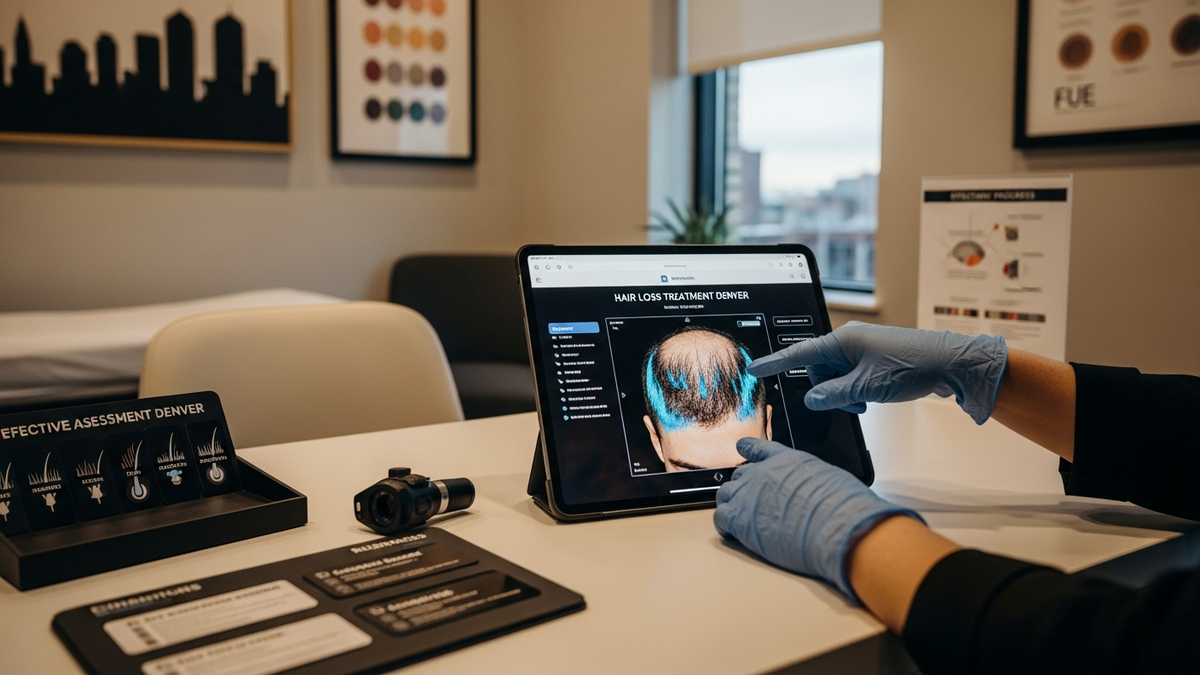
Step 1: Advanced donor assessment and extraction mapping
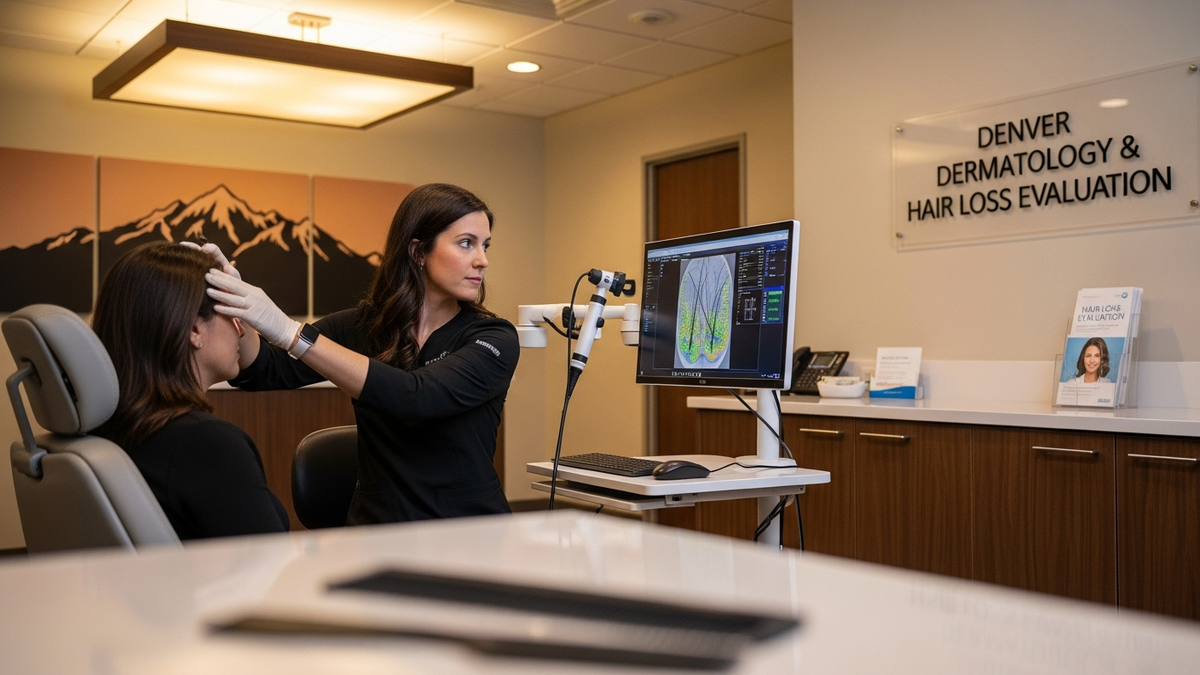
Before any extraction begins, our surgeons perform a detailed microscopic analysis of the donor region. We assess follicle density, calibre, curvature, and natural grouping to create an extraction map that aims to maximise yield while preserving donor appearance.
Step 2: Precision extraction with custom-calibrated tools
Using micro-punch tools calibrated to follicular characteristics, we extract individual follicular units with minimal trauma. Our extraction geometry is designed to support lower transection rates—one of the main determinants of graft quality and survival.
Step 3: Graft processing, preservation, and implantation
Once extracted, grafts are handled according to strict protocols, then implanted with careful attention to depth and angle. This is where natural blending is made possible—because the placement plan determines how transplanted hair grows in relation to your existing hair.
Step 4: Recovery timeline and what “full results” means
Most patients can return to work in roughly 5–7 days, with visible improvement often starting around 6 months. Full results commonly take 12–18 months as transplanted follicles transition through growth cycles.
Timeline: When Will You See Hair Growth?
Hair restoration isn’t instant. Understanding the timeline reduces anxiety and helps you plan expectations realistically.
Typical milestones
- First days: mild redness and scabbing may occur; your care plan guides healing
- 2–4 weeks: shedding of some transplanted hairs can happen as follicles reset
- 3–6 months: early regrowth becomes more noticeable
- 6–12 months: density and thickness continue to improve
- 12–18 months: full maturation and final aesthetic evaluation
How We Estimate Grafts and Cost for Denver Patients
Two patients can have the same degree of visible thinning but require different graft totals based on hairline goals, density distribution, and donor characteristics. That’s why we use structured planning rather than one-size-fits-all pricing.
To help you explore potential needs before your consultation, you can review our Cost Calculator and our AI Result Simulator.
What influences graft count?
- Hair loss pattern (temples, crown, diffuse thinning)
- Existing hair characteristics (calibre, density, growth direction)
- Desired density and coverage goals
- Donor region quality and safe extraction limits
Realistic expectations for density
Most patients benefit from understanding that transplanted hair density depends on available donor follicles and your natural hair’s baseline. The goal is not to “overfill” but to restore a convincing, natural-looking result.
Hair Transplant Options Beyond the Scalp
Hair restoration isn’t limited to scalp hair. Many Denver patients also explore facial hair and brows to complete their look.
Beard transplant
If you have patchy beard growth or want a more defined facial hair pattern, our team can evaluate whether Beard Transplant is appropriate for your goals.
Eyebrow transplant
Eyebrows require careful aesthetic planning due to their unique shape and thickness. We use follicular unit extraction principles and precise placement to support natural brow definition. Learn more about Eyebrow Transplant.
Female hair transplant
Female hair loss patterns are often different from male pattern baldness. If you’re considering Female Hair Transplant, we’ll tailor planning to your hairline, parting, and density goals.
Non-Surgical Support: When It Fits Your Plan
Not everyone needs surgery first. Some patients want to avoid downtime, treat early-stage loss, or enhance results alongside surgical planning.
InFuze Non-Surgical Hair Restoration
Our Non-surgical Hair Restoration option uses a proprietary delivery system designed to stimulate the scalp environment and support follicular regrowth. Your surgeon will recommend whether non-surgical care is appropriate based on your pattern and stage.
Questions to Ask Before Choosing a Hair Transplant in Denver
When you’re comparing clinics, ask questions that reveal how the team thinks—not just what they promise. Here are high-value questions we encourage Denver-area patients to bring to their consultation.
Technique and team
- Who performs the procedure—board-certified surgeons or technicians?
- What is your approach to hairline design and blending?
- How do you assess donor quality and create an extraction map?
Planning and outcomes
- How do you estimate graft count for my goals?
- What does the recovery timeline look like for my schedule?
- How do you handle cases where density expectations must be managed?
Safety and support
- What post-procedure care will I receive?
- What warranty or assurance process do you offer?
- How are complications monitored and addressed?
Real Patient Expectations: What “Success” Looks Like
Success is not only graft survival—it’s how your hair looks in motion, in different lighting, and over time. That’s why at FUEsion Hair Clinics we guide patients through planning so the result matches your face and lifestyle.
What you can realistically expect
- Natural hairline designed for your facial proportions
- Improved density where it matters most to your aesthetic goals
- Permanent growth from transplanted follicles
- A clear timeline from early changes to full maturation
Denver Access and Clinic Planning
Many patients search locally because they want convenience and clear communication. If you’re comparing options, it helps to understand where care is delivered and how to coordinate scheduling.
For location details, you can explore FUEsion Hair Clinics Locations. If you’re ready to start, we’ll help you map out next steps with your goals in mind.
For patients specifically looking for FUEsion Hair Clinics Denver, our team supports Denver-area consultations and planning so you can move forward with clarity.

External Evidence: What Research Says About Hair Transplant Outcomes
While no two patients are identical, evidence helps us understand what drives outcomes and why technique matters.
Graft survival depends on careful handling
According to the American Society of Plastic Surgeons and widely cited surgical principles, graft viability is influenced by handling, time out of body, and minimising mechanical trauma during extraction and implantation. (See: American Society of Plastic Surgeons, https://www.plasticsurgery.org/)
FUE is widely used for follicular unit extraction
According to peer-reviewed hair restoration literature, FUE is a recognised method for extracting follicular units and has become a common approach due to its scar profile and ability to harvest individual units. (See: International Society of Hair Restoration Surgery resources, https://ishrs.org/)
Hair growth is a cycle—timelines vary
Hair regrowth typically follows a growth-cycle pattern, which is why patients commonly shed early and then regrow over months. Clinical education materials from major dermatology references support this general timeline concept. (See: American Academy of Dermatology, https://www.aad.org/)
Note on statistics: Individual results vary, and rates are not guaranteed. We use evidence-based protocols and surgeon-led planning to support the best possible outcome for each patient.
Helpful benchmarks (with context)
- Graft survival: Many surgical teams report high survival rates when protocols are followed; our internal outcomes reflect strict protocol adherence and surgeon-led execution.
- Visible improvement: Many patients see meaningful changes between 6–12 months as growth cycles progress.
- Full maturation: Final density and aesthetic blending are often assessed around 12–18 months.
How to Get Started in Denver: Book Your Consultation
If you’re ready to explore a hair transplant in Denver, the most efficient path is a consultation where we can assess your donor region, discuss your goals, and provide a clear plan. You’ll leave with actionable next steps—no guesswork.
We also offer free planning tools to help you visualise and estimate needs before your appointment. From simulator previews to graft cost estimates, our goal is to keep decision-making informed.
Ready to take the next step toward natural-looking hair restoration?
Book ConsultationFrequently Asked Questions
How much does a hair transplant in Denver cost?
Cost depends on your graft needs, hair loss pattern, and the density goals we plan with you. We provide a clear breakdown after donor assessment and surgical planning, and you can also explore estimates using our Cost Calculator.
Is a hair transplant permanent?
Transplanted follicles are designed to grow long-term, and many patients enjoy permanent results. However, hair loss can continue in non-transplanted areas, so we plan coverage thoughtfully to support natural progression.
What is the recovery timeline after FUE?
Most patients return to work in about 5–7 days, with healing guided by a personalised post-procedure plan. Visible shedding can occur within weeks, while noticeable regrowth often begins around 3–6 months.
Who performs the procedure at FUEsion Hair Clinics?
Our board-certified surgeons lead the process under strict protocol. We focus on consistent execution so your procedure is handled with the same precision from planning through implantation.
Can I see hair transplant before and after results?
Yes. We share Hair Transplant Before and After examples so you can understand how outcomes look across different patterns of loss. Your consultation will determine what’s realistic for your unique anatomy.
Author and Clinical Expertise
Author: FUEsion Hair Clinics Clinical Team. We’re a surgeon-led hair restoration clinic focused on AI & AR Assisted FUE precision and patient-first planning for Denver-area clients.
Medical Information Disclaimer
This content is provided for general educational purposes only by FUEsion Hair Clinics. It is not a substitute for professional advice, diagnosis, or treatment. Readers are advised to consult qualified professionals for personalized recommendations.