
Choosing a hair transplant Miami FL clinic isn’t just about finding the lowest price. It’s about matching the technique to your hair-loss pattern, donor quality, and long-term goals. Whether you’re exploring FUE (Follicular Unit Extraction) or FUT (Follicular Unit Transplantation), the best results come from meticulous planning, realistic expectations, and a surgeon-led approach.
Below, we’ll cover who is typically a candidate, what to ask during consultation, when you can expect visible improvements, where Miami-area clinics fit into your options, and how to compare outcomes responsibly. For additional service details, you can review the clinic’s hair transplant offerings.
Why Miami FL Is a Popular Choice for Hair Restoration
Miami attracts patients from across the U.S. and internationally due to its concentration of specialized medical services and a strong culture of aesthetic and regenerative care. People often choose Miami because it’s convenient for travel, offers a wide range of surgical expertise, and supports aftercare planning.
At the same time, location should not be the only decision factor. A great hair transplant outcome depends on clinical fundamentals: donor management, graft handling, careful recipient-site creation, and post-op monitoring. Clinics like TestBiz Hair Clinic position themselves as a premium option using state-of-the-art technology and offering both FUE and FUT to match different patient needs.
FUE vs FUT: What’s the Difference for Hair Transplant Miami FL Patients?
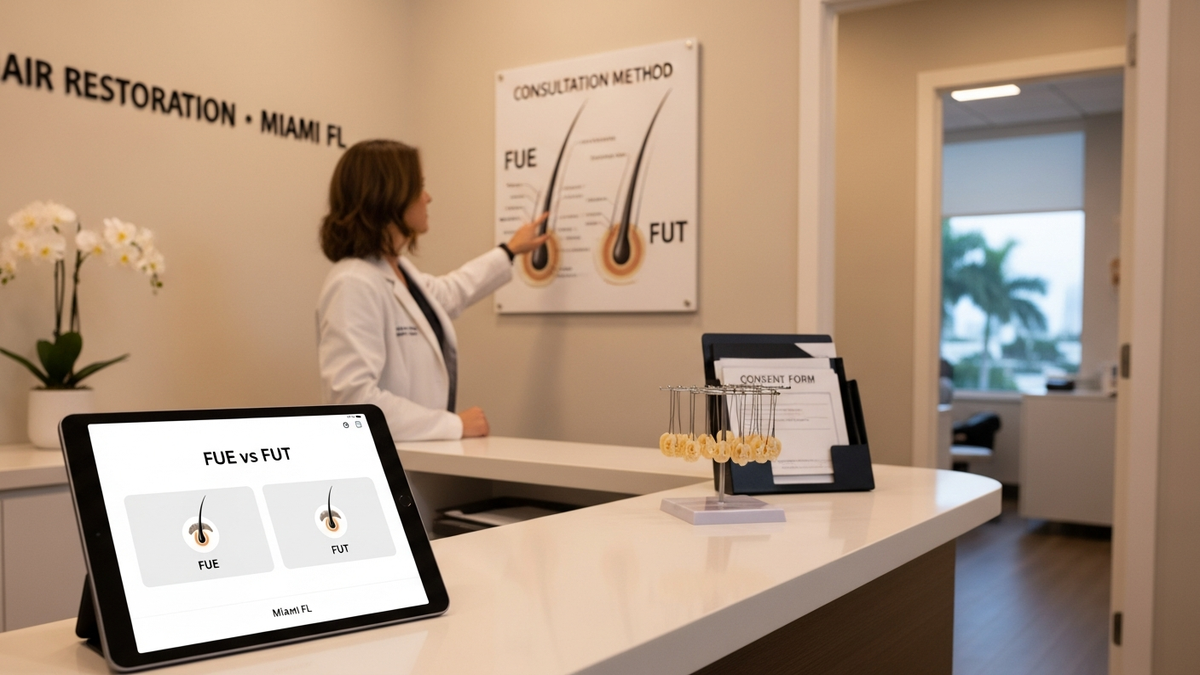
Most people comparing options for a hair transplant in Miami FL will encounter two main surgical methods: FUE and FUT. The “right” method depends on your donor supply, scalp characteristics, and the pattern of loss.
FUE (Follicular Unit Extraction): Small Punches, No Linear Scar
With FUE, individual follicular units are harvested using tiny punches. This technique is commonly chosen by patients who prefer minimal visible scarring and who want flexibility with shorter hairstyles (depending on donor density and healing).
Best-fit scenarios: Many patients with adequate donor supply, those concerned about a linear scar, or those aiming for a natural distribution across the frontal hairline.
FUT (Follicular Unit Transplantation): “Strip” Harvest for Efficient Graft Yield
With FUT, a strip of scalp is removed from the donor area and dissected into grafts. FUT can be efficient for certain cases where a larger number of grafts is needed, and it may be advantageous depending on how your donor region is structured.
Best-fit scenarios: Patients who may require higher graft counts and have donor characteristics that suit strip harvesting.
How to Choose Between FUE and FUT (A Practical Checklist)
Instead of treating FUE vs FUT as a “winner-takes-all” debate, use a structured comparison. During your hair transplant Miami FL consultation, ask how the clinic will decide between FUE and FUT for your case:
- Donor evaluation: How does the clinic measure donor density and hair caliber?
- Hairline design: Is the hairline planned for your age, facial proportions, and future loss?
- Graft strategy: How many grafts are planned for each zone (front, mid-scalp, crown)?
- Exit plan: What happens if you need additional sessions later?
- Team involvement: Who performs the key steps (extraction, dissection, implantation)?
Who Is a Good Candidate for Hair Transplant in Miami FL?
A successful hair transplant is less about “wanting it” and more about having the right biological inputs. In general, good candidates for hair transplant Miami FL procedures have stable or slowly progressive hair loss, sufficient donor hair, and realistic expectations about timeline and density.
Common Candidate Profiles
- Men with pattern hair loss: Often suitable when the donor area is healthy and the hair-loss pattern is well defined.
- Women with appropriate donor density: Women can be candidates, but planning is especially important due to different patterns of thinning.
- Those with limited scarring risk considerations: Patients who prefer certain scarring profiles may lean toward FUE (depending on donor characteristics).
Situations That May Require Extra Caution
- Active or rapidly progressing hair loss: Some people benefit from medical stabilization before transplant planning.
- Low donor density: If donor supply is limited, the focus may shift to optimizing coverage or combining surgical and medical approaches.
- Unrealistic goals: A responsible clinic will discuss what density can realistically be achieved with available grafts.
Before Your Consultation: What to Prepare
Preparation helps you and the clinic move faster and make better decisions. For anyone planning a hair transplant Miami FL procedure, here’s what to bring and discuss:
Bring Medical and Hair History
- Current medications and supplements (including hair-loss medications)
- Any history of scalp conditions (dermatitis, psoriasis, infections)
- Prior hair restoration procedures, if any
- Family history of hair loss progression
Ask for Documentation and Evaluation Methods
A premium consultation should include standardized evaluation such as hair density assessment and photographs under consistent lighting. Ask how the clinic uses these records to plan your graft distribution and track progress.
Discuss Your Lifestyle and Timeline
Recovery varies by individual and procedure type. If you have work travel or events, share your schedule so the clinic can tailor post-op guidance.
The Hair Transplant Process: Step-by-Step (How It Works)
Understanding the workflow reduces anxiety and helps you evaluate whether the clinic follows evidence-informed standards. A typical hair transplant Miami FL journey includes the following steps:
1) Personalized planning and zone mapping
The surgeon maps your hair-loss pattern and designs recipient sites to support a natural look. This includes hairline planning, mid-scalp restoration, and crown strategy when needed.
2) Donor harvesting (FUE or FUT)
For FUE, follicular units are extracted individually. For FUT, a donor strip is harvested and processed into grafts. The goal is consistent graft quality and careful donor-site management.
3) Graft preparation and implantation
Implantation involves creating recipient sites and placing grafts at angles and depths that mimic natural growth direction. This step heavily influences final aesthetics.
4) Immediate post-op care and monitoring
You’ll receive instructions on hygiene, medication use, and activity limits. Follow-up visits help ensure proper healing and address concerns early.
5) Growth timeline and realistic expectations
Hair shedding can occur after surgery as part of the natural cycle. New growth typically develops over several months, with meaningful improvements often visible by months 6–12 (individual results vary).
Recovery in Miami FL: What to Expect Week by Week
Recovery guidance can differ by technique and personal healing, but the milestones are generally similar. When you schedule a hair transplant Miami FL procedure, plan your first days for rest and your first weeks for careful scalp protection.
First 7–10 Days
- Swelling and mild discomfort: Common early after surgery; follow medication guidance.
- Scab formation: Normal during healing; avoid picking.
- Sleep positioning: Clinics often recommend specific sleeping arrangements to protect grafts.
Weeks 2–4
- Healing continues: Scabs shed and the scalp gradually looks more settled.
- Return to routine: Many patients resume non-strenuous activities as cleared by their care team.
Months 2–6
- Shedding phase: Existing transplanted hairs may shed before new growth begins.
- New growth onset: Early signs may appear, but density still develops gradually.
Months 6–12+
- Visible improvement: Many patients see the most noticeable changes during this window.
- Final refinement: Some results continue to mature beyond 12 months.
Hair Transplant Costs in Miami FL: What Influences Price?
Pricing for hair transplant Miami FL procedures varies based on graft count, technique (FUE vs FUT), complexity of recipient-site creation, and clinic expertise. While it’s tempting to compare “per graft” numbers, responsible cost evaluation includes what’s included in the service.
Key Cost Drivers
- Graft number: Larger restoration areas typically require more grafts.
- Zone complexity: Frontal hairline creation can be especially detailed.
- Donor quality: Dense, healthy donor supply may support different planning than low-density areas.
- Surgeon-led protocols: Premium clinics often emphasize quality control, standardized follow-up, and team training.
- Medication and aftercare: Some packages include post-op support and growth optimization guidance.
What to Ask About “All-In” Pricing
When comparing quotes in Miami, ask whether the price includes:
- Pre-op evaluation and standardized photography
- Post-op medications and follow-up visits
- Aftercare instructions and any additional scalp support
- Any revision policy and how it’s handled
How to Evaluate Clinic Quality (Beyond Marketing)
Not all hair transplant Miami FL providers deliver the same level of artistry and consistency. Here are practical, high-signal evaluation steps you can use before committing.
Look for Evidence of Process, Not Just Photos
- Before-and-after consistency: Are images taken in similar lighting and angles?
- Natural hairline design: Does the hairline look age-appropriate and density-balanced?
- Donor management: Are donor outcomes considered to preserve future options?
Ask Who Performs Each Step
A premium clinic clearly explains responsibilities. For example, you should understand who performs extraction, dissection, and implantation, and how quality is checked during surgery.
Confirm Medical Safety Standards
Ask about sterilization protocols, anesthesia practices, and emergency readiness. If a clinic discourages questions, that’s a red flag.
Use Credible Medical Context
Hair restoration is a medical procedure. For foundational information on androgenetic alopecia and treatment approaches, consult reputable medical resources. According to the American Academy of Dermatology (AAD), pattern hair loss is common and often responds to evidence-based approaches, which can include medical therapy alongside surgical options.
Realistic Results: What You Can Expect From FUE and FUT
When people search for hair transplant Miami FL options, they often want certainty—yet results depend on biology and planning. A responsible clinic should explain what “success” means for your case: coverage, density, and natural direction of growth.
Why Hair Density Doesn’t Happen Overnight
Transplanted hairs follow the hair cycle. After surgery, some shedding is expected. New growth occurs gradually as follicles transition into the growth phase. This is why timelines matter more than immediate visual changes.
What Affects Final Appearance
- Donor quality and caliber: Strong donor characteristics support better long-term outcomes.
- Recipient-site technique: Angle, depth, and spacing influence the final look.
- Scalp health: Inflammation or uncontrolled scalp conditions can affect results.
- Future hair-loss progression: A plan should account for ongoing changes over time.
Statistics That Matter (With Sources)
Hair-loss decisions are personal, but it helps to ground expectations in broader evidence. Here are a few widely cited points relevant to understanding hair loss and treatment:
- Prevalence: The AAD notes that androgenetic alopecia (male/female pattern hair loss) affects a large portion of the population over time. According to the American Academy of Dermatology, pattern hair loss is common and typically progresses gradually.
- Medical therapy role: Many patients benefit from medical options (when appropriate) to support hair-loss stabilization. According to the NHS guidance on hair loss, treatments may vary by cause, and some conditions improve with appropriate management—highlighting why a tailored approach matters.
Note: Statistics can’t predict your personal outcome, but they help frame why clinics focus on assessment, long-term planning, and medical-surgical alignment.
How to Prepare for Surgery and Protect Your Results
Beyond the procedure itself, your habits before and after surgery can influence healing and comfort. Use these actionable recommendations as general guidance for hair transplant Miami FL patients.
Before Surgery
- Follow medication instructions: Don’t stop or start medications without your clinic’s guidance.
- Avoid smoking and limit alcohol: These can affect healing for many medical procedures.
- Plan transportation and support: Arrange a ride home and help for the first day.
- Prepare your recovery space: Comfortable pillows, easy-to-wear clothing, and a clean environment.
After Surgery
- Protect grafts: Avoid scratching, picking, or aggressive washing until cleared.
- Follow wash schedules: Clinics usually provide step-by-step instructions.
- Manage stress and sleep: Healing is easier when your routine supports recovery.
- Attend follow-ups: Check-ins help catch issues early.
CTA: Book a Hair Transplant Consultation in Miami FL
If you’re considering a hair transplant in Miami FL, the most important next step is a personalized evaluation. A consultation helps confirm candidacy, compare FUE vs FUT based on your donor supply, and build a plan aligned with your timeline and aesthetic goals.
Frequently Asked Questions
How soon will I see results after a hair transplant in Miami FL?
Most patients notice early changes gradually, with visible improvement typically developing over months. Hair shedding can occur in the early healing period, followed by new growth as follicles transition through the hair cycle. Your clinic will provide a timeline tailored to your procedure and graft strategy.
Is FUE or FUT better for hair transplant Miami FL patients?
Neither technique is universally “better.” The best method depends on donor density, hair-loss pattern, and your preference regarding scarring and recovery. A responsible surgeon will recommend FUE or FUT based on your evaluation rather than a one-size-fits-all approach.
What should I ask during my consultation?
Ask how the clinic evaluates donor supply, designs your hairline, and plans graft distribution across zones. Also inquire who performs extraction and implantation, how post-op care works, and what realistic density improvements look like for your case. Request standardized before-and-after documentation taken under consistent conditions.
Are there risks or side effects?
Like any surgical procedure, hair transplant surgery can involve risks such as infection, swelling, scarring, or temporary shedding. The likelihood and severity of side effects depend on technique, patient factors, and aftercare. Your clinic should discuss risk mitigation and follow-up support clearly.
Can I travel to Miami for my procedure?
Many patients travel for hair restoration, but you should plan carefully for early recovery. Ask the clinic about recommended travel timing, lodging considerations, and what support you’ll have during the first days after surgery. Your schedule should prioritize rest and graft protection.
What a Premium Hair Restoration Workflow Looks Like
A clinic’s workflow is often the difference between “good” and “exceptional.” In a premium setting like TestBiz Hair Clinic, the focus is on careful planning, consistent surgical technique, and structured follow-up—so patients understand each stage of the hair transplant process.


External Resources for Further Reading
- According to the American Academy of Dermatology (AAD), androgenetic alopecia is common and progresses gradually, which is why long-term planning matters.
- According to the NHS, hair loss causes vary and treatments depend on the underlying condition, supporting the need for individualized assessment.
- For general medical context on surgical hair restoration and patient expectations, the National Center for Biotechnology Information (NCBI) hosts peer-reviewed research you can explore with your clinician.
Medical Information Disclaimer
This content is provided for general educational purposes only by FUEsion Hair Clinics. It is not a substitute for professional advice, diagnosis, or treatment. Readers are advised to consult qualified professionals for personalized recommendations.